

Past chatbots, into agents
Three years after ChatGPT reignited AI investment, the focus has shifted from improving large language models to building agentic systems on top of them, spanning copilots, autonomous automations and digital twins.
Many proofs of concept are now colliding with messy realities: agents gone rogue, data quality gaps and new compliance risks. For a Canadian defence supplier, that last phrase — compliance risks — deserves your full attention, because your compliance obligations are about to be written into your contracts.
Automating a broken process just makes it fail faster
The most useful statistic in enterprise AI right now is about failure. Gartner predicts 40% of agentic projects will fail by 2027 — not because the technology doesn't work, but because organizations are automating broken processes instead of redesigning operations. If your quoting workflow or document control is a mess, an agent makes the mess faster and with more confidence.
The economics carry a matching warning. Token costs have dropped 280-fold in two years, yet some enterprises are seeing monthly bills in the tens of millions because usage exploded faster than costs declined. Cheap per unit, expensive in aggregate. The oldest trap in technology, in a new outfit.
If your quoting workflow or document control is a mess, an agent makes the mess faster — and with more confidence.
Ottawa has made where the data goes a procurement issue
Most companies adopting AI worry about cost and quality. You also have to worry about where the data goes, because Ottawa has made that a procurement issue. The Defence Industrial Strategy treats IP and data as foundational to sovereign capability, prioritizes Canadian IP ownership and protection in defence procurement, and commits to helping industry understand, secure and leverage IP and data. Meanwhile the CPCSC makes cybersecurity a standing requirement in select defence contracts starting summer 2026.
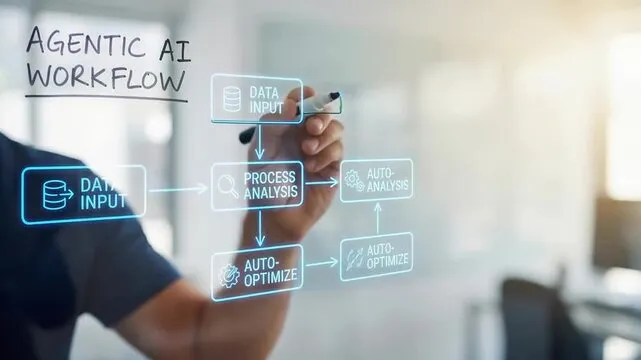
Now hold that against how agentic AI actually works. Agents read documents, query systems, and increasingly talk to services outside your walls. The next frontier in enterprise AI is interoperability, with open standards letting agents from different platforms autonomously discover, negotiate, and exchange services with one another. Useful for productivity. Also a growing list of places your controlled information could end up if nobody set boundaries.
An engineer pasting a technical drawing into a consumer chatbot to "summarize the spec" has just moved contract-sensitive data to a foreign cloud. No malice, no hack, and potentially a problem for your certification posture and your customer relationship all the same.
AI is quietly moving back on-premises
The industry is quietly moving your way. Rising token costs, security risks, and operational realities are driving AI back on-premises, and trust and security are becoming priorities as enterprises sharpen their focus on AI sovereignty. Advances in distillation, quantization and memory-efficient runtimes are pushing inference to edge clusters and embedded devices, driven by cost, latency and data-sovereignty needs.
Smaller, local models have gotten good enough that running sensitive workloads inside your own perimeter is now a practical choice rather than a luxury. For a supplier handling controlled information, local AI aligns with what your contracts will demand anyway — and it makes Canadian data-protection expectations far easier to satisfy.
Adopt AI with the discipline the CPCSC will require
- Fix the process before automating it. The 40% failure rate lives here. Redesign the workflow, then hand it to an agent.
- Classify before you deploy. Decide which data agents may touch and which never leaves your network. Contract-sensitive material, technical data and anything touching controlled goods stays home; marketing copy can go wherever it likes. Data loss prevention makes that boundary enforceable.
- Prefer local or Canadian-hosted models for sensitive work. The tooling exists and keeps improving. Your CPCSC documentation gets easier when the answer to "where does this data go" is "nowhere."
- Pilot on low-stakes internal work. Learn the failure modes on meeting notes and internal search, not on bid documents.
- Watch the meter. Usage limits and cost alerts from day one.
- Log what agents do. When an assessor or a prime asks how AI touches contract data, "we have records" beats "we think it's fine." Pair that with access control and monitoring so the record is trustworthy.
Agentic AI is a genuine advantage for defence SMBs that can't hire armies of staff. The suppliers who win will adopt it with the same discipline the CPCSC is about to require of everything else they do: know where the data lives, control who and what touches it, and keep evidence. Treat AI governance as part of your certification posture rather than a separate project, and you build the capability once.
Innovate on your terms, inside your perimeter
Scalogic Technologies helps Canadian defence suppliers adopt AI without leaking the crown jewels: data classification, on-prem and Canadian-hosted deployment, network security and the monitoring that catches an agent doing something it shouldn't.
Innovate on your terms, inside your perimeter. See our Cybersecurity & SOC and cloud services →
Frequently asked questions
Why do agentic AI projects fail?
Gartner predicts 40% of agentic AI projects will fail by 2027 — not because the technology doesn't work, but because organizations automate broken processes instead of redesigning operations first. An agent handed a messy quoting or document-control workflow just makes the mess faster and with more confidence. Fix the process before you automate it.
Why is where AI data goes a defence procurement issue in Canada?
The Defence Industrial Strategy treats IP and data as foundational to sovereign capability and prioritizes Canadian IP ownership and protection, while the CPCSC makes cybersecurity a standing requirement in select defence contracts starting summer 2026. Because agents read documents, query systems and talk to outside services, uncontrolled AI can move contract-sensitive data to a foreign cloud and affect your certification posture.
Can defence suppliers run AI without sending data to a foreign cloud?
Yes. Rising token costs, security risks and data-sovereignty needs are pushing inference back on-premises and to the edge, and advances in distillation, quantization and memory-efficient runtimes mean smaller local models are now good enough for many sensitive workloads. Running them inside your own perimeter — or on Canadian-hosted infrastructure — is a practical choice rather than a luxury.
What is a safe way to adopt agentic AI as a defence SMB?
Fix the process before automating it, classify data so contract-sensitive material never leaves your network, prefer local or Canadian-hosted models for sensitive work, pilot on low-stakes internal tasks, watch usage and cost from day one, and log what agents do so you can show an assessor or prime how AI touches contract data.
This article is general information, not legal or professional advice. Statistics and policy references are drawn from publicly reported figures, including Gartner's agentic AI forecast, the Canadian Defence Industrial Strategy, and the Canadian Program for Cyber Security Certification (CPCSC). Confirm current requirements against official sources and your specific contract terms.